
Short answer: A Class A fire rated roof is a roof assembly that has passed the highest level of the ASTM E108 and UL 790 fire tests. It resists severe fire exposure from outside the building, which is the exposure that matters in a wildfire. Class A is the top of a three level scale, ahead of Class B and Class C, and California requires a Class A assembly on new residential roof coverings.
The rating sounds simple. What it actually covers, and what quietly removes it, is where homeowners get surprised.
The three classes, briefly
Roof coverings are graded on how they respond to fire coming from the outside, not from inside the house:
- Class A. Effective against severe fire exposure. Metal, clay tile, concrete tile, slate, and modern fiberglass mat asphalt shingles all reach this level in the right assembly.
- Class B. Effective against moderate exposure.
- Class C. Effective against light exposure.
- Unrated. Fails the testing. Untreated wood shake is the familiar example.
For a side by side look at how the main roofing materials compare on fire resistance, start with our overview and come back here for the rating itself.
The three tests behind the rating
ASTM E108 is not one test. A roof assembly has to survive three, all performed on a deck built at the slope the assembly is rated for.
1. The burning brand test
A flaming wood brand is set on the roof and allowed to burn out. This simulates a large ember landing and sitting there. For Class A the brand is the largest of the three sizes used, roughly a foot square, and it burns for a long time. The assembly fails if fire penetrates to the underside or the deck ignites.
2. The spread of flame test
Flame is directed at the assembly and the distance fire travels across the surface is measured. Class A allows the shortest spread.
3. The intermittent flame test
Flame is applied and withdrawn in cycles, over and over, to see whether the assembly sustains combustion on its own once the flame source is gone.
Passing all three at the top threshold earns Class A. That burning brand test is the one that matters most in Los Angeles, because a wind driven ember shower is exactly what it recreates.
Class A by assembly versus Class A stand alone
This is the distinction almost nobody explains, and it is the reason two roofs with the same panel can perform differently.
Stand alone rating. The covering passes on its own, over a range of decks, without depending on a specific layer beneath it. Clay and concrete tile commonly fall here.
Rated by assembly. The covering passes as part of a specific tested system. The panel, the underlayment, and the deck were tested together and listed together. Many metal roofing systems achieve Class A this way, typically over a listed fire rated underlayment on a solid deck.
Both are genuinely Class A. The catch is that an assembly rating only describes your roof if your roof was built to match the listing. If a crew substitutes a cheaper underlayment, installs over spaced sheathing instead of a solid deck, or adds an unlisted layer underneath, the roof on the house is no longer the assembly that was tested, even though the panel is identical and the invoice says metal roof.
Ask which listed assembly is being installed. Ask for it in writing. A roofer who builds these regularly will have the answer immediately.
How to tell whether your existing roof is Class A
Four places to look, in order of how reliable they are:
- Your permit and final inspection records. A permitted reroof in Los Angeles will have the roof covering and its class recorded. The Building and Safety file for the address is the strongest evidence.
- The installer’s documentation. The listed assembly number, the underlayment product, and the manufacturer’s listing should all be in your closeout paperwork.
- The manufacturer’s product listing. Roofing manufacturers publish which of their systems carry Class A and under what conditions. The condition line is the part to read.
- A certification directory lookup. Listed assemblies are published by the testing agency and searchable by manufacturer and assembly number.
What is not reliable: assuming a material is automatically rated. Metal, tile, and asphalt can each be Class A or not depending on how they were installed. If a previous owner reroofed without a permit, treat the rating as unknown until it is verified.
Where California requires Class A
California requires a Class A roof assembly on new residential roof coverings, which makes this the baseline for any reroof rather than an upgrade. In a Very High Fire Hazard Severity Zone or the Wildland Urban Interface, Chapter 7A of the building code adds requirements for the rest of the exterior, including ember resistant vents, enclosed eaves, and ignition resistant materials.
Requirements are assigned parcel by parcel, so confirm the classification for your specific address before you plan the work. Two houses on the same street can sit in different zones.
How a metal roof reaches Class A
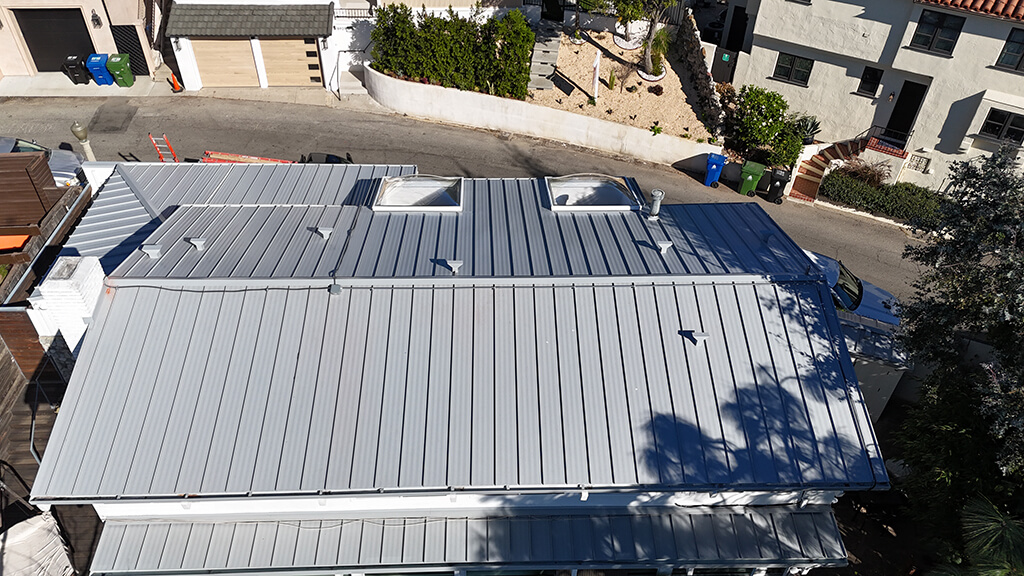
A standing seam metal roof starts with a real advantage: steel and aluminum are noncombustible, so the covering itself cannot ignite or feed a fire. The assembly is completed with a listed fire rated underlayment over a solid deck, and the continuous locked seams leave very little for a landing ember to get under.
The same logic applies to corrugated metal roofing when it is installed as a listed system. The panel profile changes the look, not the chemistry.
For homes in the Hollywood Hills, Bel-Air, and the canyon neighborhoods, this pairing of a noncombustible surface with a documented assembly is why metal keeps coming up in the conversation.
What can quietly cancel a Class A rating
A rating earned on install day can be undone later:
- Substituted underlayment during a repair or a partial replacement.
- New penetrations cut for solar, satellite, or vents and then sealed with caulk instead of flashed into the system.
- Added layers installed over the original covering.
- Foam or insulation applied beneath the deck that was not part of the tested assembly.
- Deferred maintenance at valleys and flashings, which opens the ember paths the assembly was tested to close.
Keep the paperwork from the original install, and hand it to anyone who touches the roof afterward.
Frequently asked questions
Is every metal roof Class A?
No. The metal itself is noncombustible, but the Class A rating applies to the tested assembly. A metal panel over the wrong underlayment or an unsuitable deck may not match any listed Class A system.
What is the difference between Class A and Class B?
Both are legitimate ratings, and Class A resists more severe exposure. In the burning brand test, Class A is evaluated with a much larger, longer burning brand than Class B.
Is Class A the same as fireproof?
No, and no roof is fireproof. Class A is the highest tested resistance to fire coming from outside the building. It buys time and greatly reduces the chance of ignition, which in an ember event is usually the whole game.
Do I need a Class A roof if my home is not in a fire zone?
California requires a Class A assembly on new residential roof coverings regardless, and homes outside mapped high hazard zones still receive embers on a windy day.
Does a Class A roof need special maintenance?
Not special, but consistent. Keep valleys and gutters clear, keep vent screening intact, and have flashings checked periodically. The assembly performs as tested only while it is intact.
Get your roof’s rating verified
If you are not certain what is on your house or what class it carries, we can inspect the roof, review the permit history, and tell you plainly where you stand.
Call Eclipse Metal Roofing at (310) 490-9695 or schedule an inspection. We fabricate every panel at our own fabrication shop in Van Nuys and install with our own crews, so the assembly on your home is the assembly that was specified. Nearly 20 years of metal roofing in Los Angeles, built to last.