
Short answer: Fire resistant roofing is a roof assembly that has been tested and rated for how well it holds up to fire arriving from outside the building. The highest level is Class A. Metal, clay tile, concrete tile, and slate can all reach Class A. The rating belongs to the full assembly, meaning the covering plus the underlayment and the deck beneath it, not to the surface material on its own.
That last sentence is the part most homeowners never hear, and it is the part that decides whether a roof performs the way the brochure promised.
The roof is where a wildfire usually gets in
Homes in a wildfire zone are rarely lost to a wall of advancing flame. They are lost to embers. Wind carries burning debris well ahead of the fire itself, sometimes more than a mile, and those embers land somewhere. On a house, the largest, flattest, most exposed surface available is the roof.
Embers collect in roof valleys, behind chimneys, in gutters packed with dry needles, and at the open ends of tile courses. If they find anything combustible, or any gap into the attic, the fire starts at the top of the house and works down. This is why a roof that resists ignition matters more than almost any other exterior choice a homeowner in the hills makes.
What “fire resistant” actually means
Roofing is not called fire resistant based on marketing language. It is tested under ASTM E108 and the equivalent UL 790 standard, which run a roof assembly through three separate exposures:
- Burning brand test. A flaming wood brand is placed on the roof to simulate a large ember landing on it.
- Spread of flame test. Flame is applied to see how far fire travels across the surface.
- Intermittent flame test. Fire is applied and removed repeatedly to see whether the assembly keeps burning on its own.
The results sort roofs into three classes:
- Class A withstands severe fire exposure. This is the top rating.
- Class B withstands moderate exposure.
- Class C withstands light exposure.
Anything that fails all three is unrated. Untreated wood shake is the classic example, and it is exactly why so many older hillside roofs in Los Angeles have been replaced.
If you want the testing broken down in more detail, including how to check the rating on a roof you already own, read what a Class A fire rating actually measures.
The rating belongs to the assembly, not the panel
Here is where a lot of money gets spent on the wrong thing.
A fire rating is issued to a tested assembly. Two roofs can use the identical metal panel and land in different places, because one was installed over a listed fire rated underlayment on a solid deck and the other was not. Some coverings carry a stand alone Class A rating, meaning the material passes on its own over almost any deck. Many others, including a number of metal systems, reach Class A by assembly, meaning the panel plus the specified underlayment plus the deck were tested together as one system.
Both are legitimate Class A. The difference is that an assembly rating only holds if the roof is built the way it was tested. Swap the underlayment for something cheaper, skip the solid deck, or add an unlisted layer underneath, and the rating on the paperwork no longer describes the roof on the house.
This is a documentation issue as much as a materials issue. Ask any roofer which listed assembly they are installing, and ask to see it in writing.
How common Los Angeles roofing materials compare
Metal
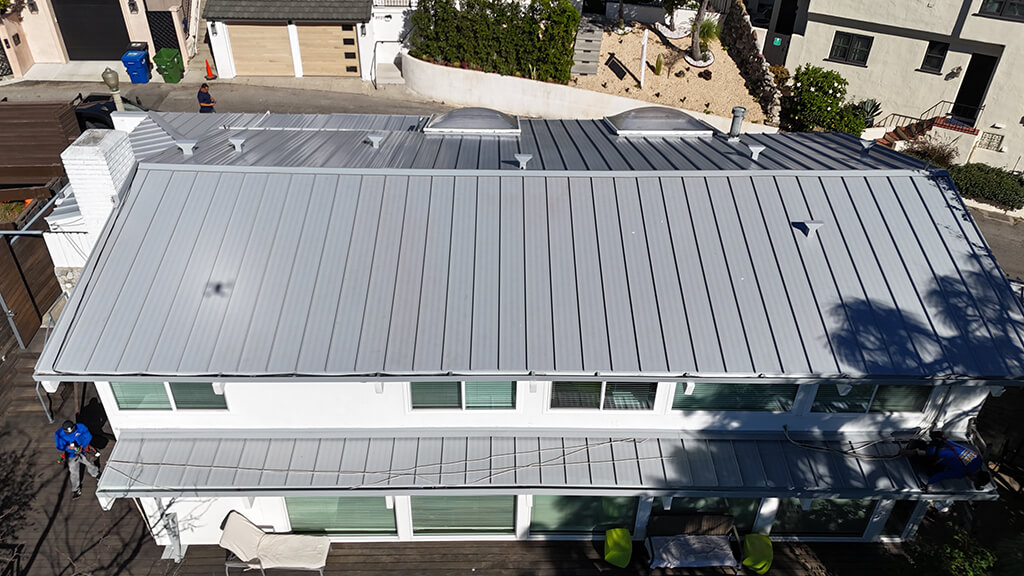
Steel and aluminum are noncombustible. They will not ignite, and they will not feed a fire. Installed over the correct underlayment and deck, a standing seam system reaches Class A, and the continuous locked seams leave very few openings where an ember can work its way underneath. That combination of a noncombustible surface and a tight, sealed plane is why metal is so common on canyon and ridge homes.
Clay and concrete tile
The tile itself will not burn and these roofs commonly reach Class A. The weak point is the open end of each tile course, where embers can blow into the cavity beneath. Bird stops and properly detailed ends matter a great deal here.
Slate
Noncombustible and long lived, with weight and structural requirements that rule it out for many houses.
Asphalt shingle
Modern fiberglass mat shingles are typically rated Class A as an assembly. They perform, but they are an organic surface with a limited service life in intense sun.
Wood shake
Pressure treated shake can be rated, but untreated shake is not, and treatments do not last forever. In a high hazard zone this is a material to move away from.
Details that matter as much as the covering
A Class A roof on a house with open eaves and unscreened vents is a Class A roof with a side door propped open. In California’s Wildland Urban Interface, the building code addresses the whole exterior envelope, not the roof surface alone:
- Vents need ember resistant screening or listed ember resistant vents.
- Eaves and soffits need to be enclosed or built with ignition resistant materials.
- Gutters should be kept clear, and covers help, since a gutter full of dry debris is a fuel bed sitting on the roof edge.
- Valleys and roof to wall junctions need clean, tight flashing with no gaps for embers to enter.
- Skylights and solar penetrations need to be flashed into the system, not caulked over it.
California requires a Class A roof assembly on new residential roof coverings, and the rules tighten further in Very High Fire Hazard Severity Zones, where Chapter 7A governs the rest of the envelope. Requirements vary by parcel, so confirm what applies to a specific address before planning a reroof.
Choosing a fire resistant roof for a hillside home
For homes in Pacific Palisades, Malibu, Bel-Air, and the Hollywood Hills, the material conversation usually ends up in the same place: a noncombustible surface, a listed Class A assembly, and details tight enough that embers have nowhere to land and nothing to enter.
Metal delivers that without forcing a compromise on how the house looks. Standing seam metal roofing suits clean, modern architecture, and for traditional homes there are metal panels shaped like shake, tile, or slate that keep the original character of the house. Reflective finishes bring a second benefit as well, since the same panel can also work as reflective, energy efficient roofing through a Los Angeles summer.
At Eclipse Metal Roofing we fabricate every panel in our own Van Nuys shop and install with our own crews. No subcontractors, ever. On a fire rated assembly that matters more than it sounds, because the rating survives only if every layer and every detail is built exactly as it was tested.
Frequently asked questions
Is a metal roof fire resistant?
Yes. Steel and aluminum are noncombustible and will not ignite from an ember. To carry a Class A rating, the panel must be installed as part of a tested assembly, which usually means a listed fire rated underlayment over a solid deck.
What is the most fire resistant roofing material?
Metal, clay tile, concrete tile, and slate all reach Class A, which is the highest rating available. Metal has the added advantage of a continuous, tightly sealed surface with very few openings where embers can collect or enter.
Does a Class A roof affect home insurance in California?
Carriers weigh roof class and wildfire mitigation differently, and some ask for it directly on hillside properties. Ask your own carrier what documentation they want, and keep the assembly listing and permit records from your reroof.
Can a fire resistant roof be installed over an existing roof?
Sometimes, but a tested Class A assembly usually specifies what sits beneath it. Layering a new roof over an old one can put the finished roof outside the assembly that was tested. A tear off to the deck is the reliable path to a rating you can document.
How long does a metal roof last in Los Angeles?
A properly installed standing seam metal roof is a multi decade roof, commonly 40 to 70 years depending on the metal and the finish. It holds its fire performance for that entire service life, because the panel is noncombustible rather than treated.
Talk to a metal roofing specialist
If your home sits in a high fire hazard area and you are weighing your options, we can walk the roof, review what is currently on it, and show you exactly which Class A assembly fits the house.
Call Eclipse Metal Roofing at (310) 490-9695 or request a roof assessment. Nearly 20 years of Los Angeles metal roofing, custom fabricated in house.